Introduction to RELIGION & THEOLOGY
Religion and theology represent two of humanity’s most profound intellectual pursuits, each seeking to understand the ultimate questions of existence, meaning, and the divine. While often intertwined, these disciplines possess distinct characteristics that have shaped civilizations throughout human history.
Religion encompasses the collective beliefs, practices, rituals, and moral codes that bind communities together in shared understanding of the sacred and transcendent. It manifests through diverse expressions across the globe, from the ancient Vedic traditions of Hinduism to the Abrahamic faiths of Judaism, Christianity, and Islam, from Buddhism’s philosophical depths to indigenous spiritual practices that predate written history. Religion operates not merely as an abstract system of beliefs but as a lived experience that permeates every aspect of human life, influencing art, literature, law, ethics, and personal identity.
The cosmic national perspective recognizes that religion serves multiple functions simultaneously. It acts as social adhesive, binding communities through shared rituals and moral expectations. It functions as an existential compass, providing answers to fundamental questions about purpose and reality. Religion has inspired humanity’s greatest artistic achievements while serving as the foundation for ethical systems that govern billions of lives.
Theology, by contrast, represents the systematic and critical study of religious beliefs, practices, and experiences. Derived from the Greek words “theos” (god) and “logos” (word or reason), theology attempts to articulate, analyze, and defend religious claims through rational discourse and intellectual rigor. It engages with scripture, tradition, reason, and experience, employing philosophical tools to examine concepts such as divine attributes, revelation, salvation, and theodicy.
The relationship between religion and theology is dynamic. Religion provides the lived tradition and sacred texts that theology examines, while theology clarifies, systematizes, and sometimes challenges religious understanding. This dialectical relationship has produced history’s most sophisticated philosophical arguments, continuing to shape how billions understand themselves and their place in the cosmos.
THE THEOLOGICAL LAW OF SEMANTIC INDETERMINACY ( i-e Word GOD )
( A New Linguistic-Cum-Philosophical Framework Proposed by Übermensch – The Cosmic National )
Introduction
Across chronicles, every major philosophical and religious wrangle has expected that the word “GOD” refers to a single, unified, and mutually understood concept but yet this supposition has never been justified. The term God works not as a single concept but as a semantic container loaded with multiples of mutually incompatible meanings across religions, cultures, languages, and philosophies.
The Theological Law Of Semantic Indeterminacy (TLSI) manifests this overlooked blemish and systematizes a rigorous linguistic and logical footing for re-examining / re-defining all God-related discourse. Therefore, any debate employs the word “GOD” without proper definition or religious meaning etc is logically invalid, Linguistically incoherent and philosophically meaningless.

Formal Statement Of The Law
Any inquiry, claim, debate, argument, statement or proof that utilizes the word “GOD” without an explicit definition, conceptual boundaries or contextual specification is invalid at every angle of knowledge and intellectual discourse.
The term GOD isn’t a singular concept but a semantic bucket that contains countless conflicting definitions i-e Creator of the universe, Uncaused cause, Personal deity, Non-personal absolute, Pantheistic totality, Metaphysical essence, Supernatural agent, Energy, Matter, consciousness, Brahman, Allah, Eshwar, Ahura Mazda, etc. Because these mental impressions don’t share a common structure, operating the single word God without clarification results in a category error and semantic overreach.
Similarly, queries such as Does God exist? Did God create the universe? Is there proof of God? etc are fundamentally invalid unless term God is defined prior to proceed.
The Linguistic Foundation: Why the Word “GOD” Is Invalid Without Relevant Definition?
Modern philosophy of language exhibits that words don’t carry meaning by themselves therefore, final meaning emerges only from definition, conceptual boundaries and internal structure etc and without these, a term appears ambiguous, non-referential, conceptually empty. The word God stands from severe semantic overload so It tries to conveys more meaning than the word structure can support. Therefore, a single word depicting hundreds of contradictory concepts can’t generate any valid debate, argument, or conclusion etc. The cosmic national perspective reinforces this understanding by examining how semantic structures function across universal discourse.

The Logical Foundation: Why Ambiguous Terms Destroy Arguments?
In analytic philosophy and logic, an argument is automatically invalid if a key term is undefined, the term changes meaning mid-argument, multiple people use the same word but mean differently. So the term God fails all three conditions. Hence:
❌ Every debate about God’s existence ❌ Every video, lecture, sermon, or argument ❌ Every philosophical proof or refutation
becomes invalid from the start if the term isn’t explicitly defined and this fallacy is called “SEMANTIC OVERREACH” when a word is employed beyond the conceptual scope it can logically sustain.

The Metaphysical Foundation: No Universal Concept of God Exists
Normally every religion is bearer of a different God-model i-e:
▪️Hinduism with millions of deities & Brahman ▪️Christianity with Trinity ▪️Islam with Allah ▪️Sikhism with Waheguru
▪️Zoroastrianism with Ahura Mazda ▪️Judaism with YHWH ▪️Philosophy with impersonal Absolute First Cause, Ground of Being etc ▪️Science with laws, energy, or emergent complexity (in some speculative frameworks)
so no two systems refer to the same object when they say the word God. Thus it might looks like that “God exists” and “God does not exist” can both be true or false depending on which definition is silently assumed. Therefore, this makes all such statements meaningless, not merely debatable. From a cosmic national standpoint, this multiplicity of definitions reveals the fundamental challenge in establishing universal theological discourse.
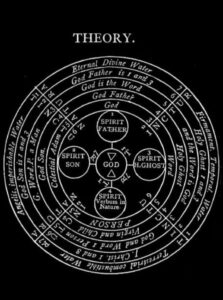
Core Insight of the Law
The word “GOD” isn’t a concept and a warehouse of concepts because it shelves incompatible attributes, contradictory definitions, culturally dependent constructs, mutually exclusive metaphysical frameworks etc that proves the term can’t participate in any valid logical or philosophical argument without prior definition.
This is the first time in the history, this flaw has been formally thought, articulated and projected accordingly through the cosmic national framework of analysis.
Required Starting Inquiry for Any God-Discussion
Every debate must begin with “What exactly do you mean by word GOD?” But religious, non-religious, and atheist thinkers etc have repeatedly failed to ask this question. This omission has allowed 2,500 years of debates to proceed on a false premise assuming a shared meaning where none survive. As per summary, God-Chat is invalid without definition because the term is semantically ambiguous, is conceptually overloaded, contains incompatible models, collapses into a category mistake, fails linguistic precision, violates analytic logic and lacks referential clarity.
Conclusion
The Theological Law Of Semantic Indeterminacy basically redesigns the point-Of-Departure of all God-related discourse. It reveals that millennia of debates spanning theology, metaphysics, science, and philosophy etc have largely been erected on an undefined, ambiguous, and conceptually unstable term.
By demanding precise definition as the starting point, the law restores logical integrity and linguistic clarity to discussions about ultimate reality. Further to ensure that this law is applicable for any word aswell that has same issues mentioned above. The cosmic national approach to semantic analysis provides a comprehensive framework for identifying and addressing similar linguistic challenges across all domains of philosophical inquiry.
__ Übermensch (The Cosmic National)